
I want to close this essay with some thoughts on the screenplay.
In his writing, Tony Gilroy tries to make every scene a battle. Some of the battles are small and provide background (Selena’s interactions with her boss) while some are large and move the whole story forward (the bank scene). But every single character interaction is a battle. This makes for compelling storytelling.
The battles in Dolores Claiborne (1995) are “courtroom” (using words) save one or two that are “boxing ring” (a physical altercation). When it comes to showing the impact on screen (because film is a visual medium) one would think boxing ring would be the easier of the two.
This is (obviously) a false dichotomy. There are many stories that do one or the other or both very well. But I’ve noticed a couple of problems with the general execution of both kinds of battles that sometimes show up in movies and their sequels.
First, the audience will naturally understand the impact of words (statements/questions/answers/truth/lies) because communicating via words (spoken or typed) is our existence. So provided the storytelling is clear, the audience intuitively understands who is winning a courtroom-style battle. The same is not true for the boxing ring.
Because most people have never been (for example) knocked out in a fistfight, the average movie-goer’s understanding of what it’s like to take an unblocked, full-power shot to the head by professional heavyweight boxer in the prime of his career is usually based on the final ten minutes of a random Rocky movie.*
This on its own is not a problem. The idea that Rocky can take beating and not go down, it really works in the Rocky movies. There are two reasons. First, they amp up the intensity in the sequels by simply making Rocky older. They don’t have to give his opponents special powers, robot arms and such.
Second, the insane, hyper-unrealistic fight only happens once, at the end of the story. Too many modern action movies will have several of these kinds of fights throughout the movie. In a protracted contest between two opponents (without taking special care to plan/metre out the hits), physical battles can lose impact as the story progresses when they move from plausible/fantastical up into the cartoonosphere where the characters routinely survive things like asteroid impacts or swallowing lit sticks of dynamite. Where’s the tension if our hero is impervious to atomic weapons?
The same thing happens in movie sequels where the character(s) in the first movie are everyday Joes and Julies but by the fourth movie they’re basically superheroes. Sometimes it works (F&F movies) and sometimes it does not (Die Hard).
Back to the courtroom battles, I feel they’re best when there’s a healthy back and forth and the final score is 10-8 like in A Few Good Men (1992). I was going to use the famous “do you like apples” scene from Good Will Hunting (1997) to give an example where the final score was 10-0 (the antagonist was simply an asshole, he started the fight, took some swings, landed none) but then I watched it on YouTube and was like, “Nope. Perfect. Change nothing.”
What affects courtroom-style conflict is the Jessica Fletcher problem. When the plausible/fantastical part of the story is the inciting incident (a possible murder) it can be challenging to find anywhere to go anywhere in the sequel that does not come off as “what are the chances?” The Hangover Part II (2011) was great but like, come on.
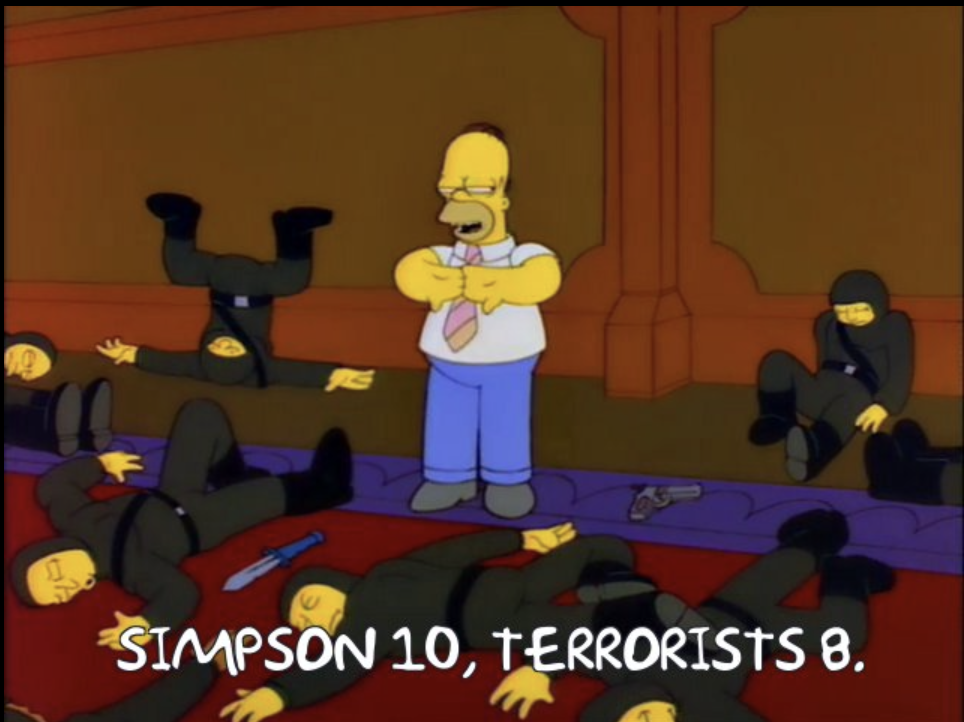
*In reality you would die 100% of the time – your head would literally detach from your body, fly across the room in a perfect parabolic arc, hitting the rim of a garbage can and circling for five seconds before falling in.


 Die Hard Three
Leave a comment